
Rewiring Media Planning in the Age of AI
- samkarow
- Apr 29
- 4 min read

AI continues to reshape media planning, while a deeper shift unfolds in how marketing organizations operate, make decisions, and create value.
Across industries, adoption has accelerated quickly. Workforce access to AI tools has expanded significantly, and a growing share of initiatives are moving beyond pilots into production environments. Yet scale alone does not guarantee impact.
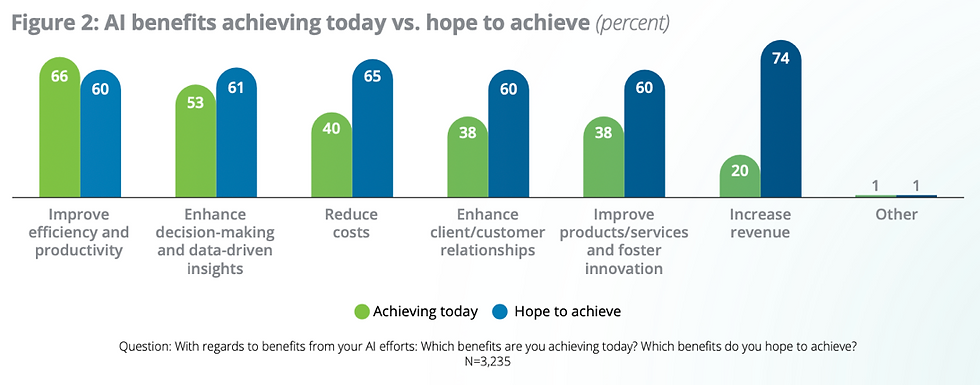
A closer look at performance outcomes reveals a gap. Data from enterprise research shows that most organizations are already capturing efficiency gains. Around two thirds report improvements in productivity, while more than half see stronger decision making supported by data. However, only a much smaller share currently link AI efforts directly to revenue growth, even though nearly three quarters expect that outcome in the future.
According to Deloitte , only 34 percent of organizations are driving deep transformation of products, processes, or business models, while 30 percent are redesigning selected workflows, and 37 percent report little or no change to existing processes. In many cases, AI is layered onto existing structures without fundamentally reshaping how work is done.

In media planning, these differences lead to very different operating models. For some teams, AI improves speed by automating reporting, targeting, and execution. For others, it influences earlier stages of planning, shaping how audiences are defined, how signals are interpreted, and how investment scenarios are evaluated before activation.
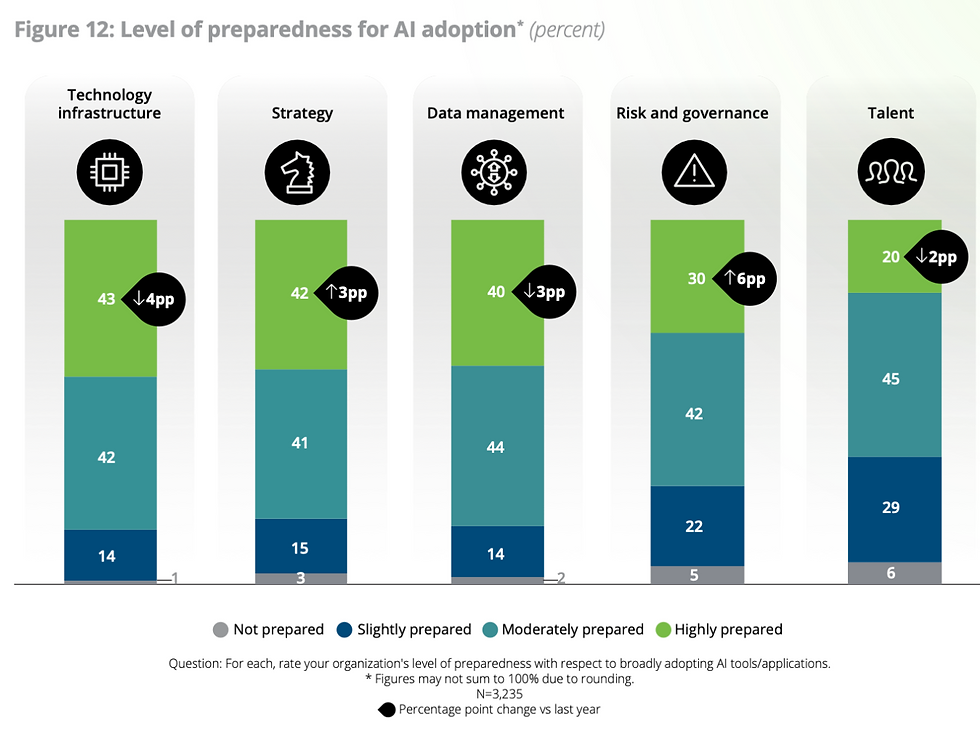
Preparedness data reinforces this imbalance. While 42 percent of organizations report high preparedness in AI strategy, lower confidence appears in areas such as data management (40 percent), governance (30 percent), and talent (20 percent). Capability development does not advance evenly, creating friction when scaling AI across planning systems that rely on coordination across teams.
PwC’s 2026 research reinforces this point, showing that organizations achieving stronger performance gains tend to combine AI adoption with operating model changes. These include clearer decision ownership, redesigned workflows, and alignment between data, technology, and business teams. Without these elements, AI improves speed without fully improving outcomes.
For media planning, performance depends less on whether AI tools are available, and more on how they are integrated into planning logic. Three shifts define this transition:
1. Planning inputs expand from static segments to dynamic signals reflecting behavior and intent.
2. Scenario modeling becomes central, allowing teams to evaluate multiple investment pathways rather than optimizing a single plan.
3. Measurement evolves into a forward-looking system that informs allocation decisions instead of explaining past performance.
At Effective , this shift directly informs how AI is applied within media planning systems.
Our approach focuses on embedding intelligence into decision frameworks and integrating it directly into the planning process. This goes beyond high-level modeling and connects AI to specific stages of marketing research, planning, and performance evaluation.
In the research phase, AI-supported environments are used to synthesize audience signals, competitive context, and category dynamics. Tools such as Effective's Brand Pulse Monitor help teams benchmark a brand’s digital presence by analyzing search demand, content visibility, and engagement patterns, providing a clearer view of where a brand stands within its competitive landscape.
In the planning phase, AI enables scenario-based decision making. Effective's Persistent Share Report connects media investment to outcomes across traffic, search, engagement, reviews, app activity, and market position. This allows teams to evaluate how different allocation strategies may influence both short-term performance and long-term share of market, rather than optimizing a single plan in isolation.
In the evaluation phase, AI-supported models provide a more structured view of performance. Effective's Media Profitability Index compares actual returns against expected outcomes based on industry dynamics and media mix, helping teams assess whether performance aligns with underlying economic logic.
Across these applications, AI functions as a layer that organizes information, surfaces relationships, and supports decision making. The focus remains on strengthening planning discipline, improving visibility into tradeoffs, and increasing confidence in investment decisions.
Governance and operating structure remain critical factors. Deloitte’s research highlights that only a small share of organizations report mature governance for advanced AI systems, even as adoption accelerates. This gap introduces risk and slows the transition from experimentation to consistent value creation.
Effective change management helps close this gap by aligning three elements:
1. Clear use cases tied to business outcomes
2. Defined roles for human oversight and decision ownership
3. Consistent frameworks that guide how AI outputs inform planning
Without this alignment, organizations often face fragmented systems where insights exist but do not influence action.
AI expands the range of available signals, increases analytical speed, and introduces new ways to evaluate performance. Meanwhile, it raises expectations for how planning processes are structured and how teams align around shared decision frameworks.
Performance differences increasingly reflect how well organizations manage this transition. Technology can accelerate execution. Competitive advantage develops when tools, people, and planning structures operate as a unified system.
As AI continues to evolve across marketing, a key question comes into focus:
How effectively does your organization connect AI capabilities to the decisions that shape media investment and business growth?
Send me a message to explore pilot campaigns, audits and other "foot in the door" projects to rewire your go to market approach.


Comments